

Printing your logo on colored PPF rolls is not "brand building," it's just a label.
For automotive importers, regional distributors, and film coating brand owners, the true core of OEM/ODM lies in addressing key operational risks: inconsistent colors between batches, orange peel effect on dark surfaces, residual glue during disassembly, and out-of-control inventory costs due to minimum order quantity (MOQ).
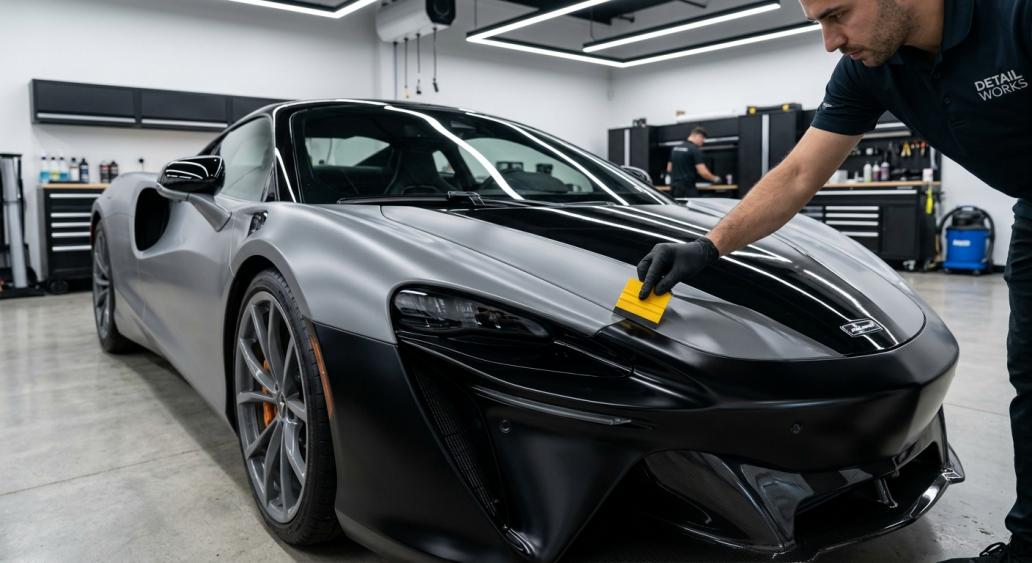
In today's market, there is a fierce price war for cheap unbranded PPF sheet materials. To win the market, we must have designed for your area market demand, climate conditions and installation preferences and design their own colour PPF production line.
This guide cuts through the redundancy to provide you with a practical blueprint for building a profitable and scalable colour PPF brand through the OEM/ODM model - covering key elements such as resin selection, pigment stability, customised packaging and quality control (QC) parameters.
The Real Difference Between OEM And ODM In The Color PPF Field
In the colored PPF industry, OEM and ODM are often used interchangeably, but for brands, they represent different levels of product involvement and supply chain control.
1. OEM: Brand presentation centered around you
OEM focuses more on leveraging a mature colored PPF product system to provide customers with branded manufacturing and market presentation.
Common content includes:
- Utilize a mature colored PPF product system;
- Customize brand logos, packaging, and labels;
- Plan model and product information according to customer requirements;
- Maintain the manufacturing processes and quality standards of mature products;
- Help brands enter target markets faster and reduce initial R&D and trial costs.
For Importers And Film Chains With Established Distribution Networks, OEM Is The Fastest Way To Achieve Asset-Light Brand Ownership.
Compared The Formula Test And Untested Raw Materials Cost Money, OEM Factory Verify, Stable Performance Of The TPU Paste Platform. This Will Enable You To Total Budget To Create Real Income Link: Market Penetration, Installation Personnel Training And Dealer Network Expansion.
The Real Value Of The Color PPF OEM Is Not In The Cheap "Private Label" - It Is In The Zero R&D Responsibility And Quick To Market. You Can Get Verified By Market In The First Day Of The Product Line, To Avoid Expensive Field Failure And Destroy The New Brand.
2. ODM: Participating In Customization At The Product Definition Level
Compared to OEM, ODM typically means that the brand can be more deeply involved in product development.
Depending on the specific factory's R&D and production capabilities, ODM may involve:
- Participate in color system and product line planning;
- Develop different colors or visual effects based on the target market;
- Specify requirements for product structure, thickness, and performance characteristics;
- Adjust the product mix according to different market positioning;
- Develop differentiated products tailored to the target customer segment;
- Gradually establish a Color PPF product system with strong brand recognition.
ODM is suitable for brands that aspire to go beyond standard catalog products and establish hard technical barriers in regional markets.
For different market segments, fundamentally different product architectures are required:
High-end fine craftsmanship segment: Focuses on factory-level depth of field performance, zero orange peel effect, high ductility without whitening, and over 5 years of UV resistance and weather resistance in extreme climates.
Mass market segment: Prioritizes high production stability, highly competitive installation costs, rapid installation efficiency, and providing higher turnover profit margins for installers.
ODM addresses the fundamental issue of brand long-term survival: "How to build an exclusive product architecture that competitors cannot easily obtain from the same original catalog."
While OEM's response is "How to quickly bring the brand to the market," ODM's response is "How to create product exclusivity to ensure your gross profit margin."
What Are The Key Customizable Dimensions Of Colored PPF?
OEM/ODM of colored PPF does not mean that all parameters can be adjusted without limitations. The production equipment, raw material systems, coating processes, and supply chain capabilities of different factories will affect the final customization range.
The following content can serve as the primary reference for brands during initial communications.
1. Customized Packaging System
In the colored PPF supply chain, packaging is much more than an expression of cosmetic beauty or logo placement - it is a key direct touchpoint that defines a brand's market positioning and an important line of defense to protect inventory during global shipping.
Poor quality packaging can lead to core damage, moisture infiltration, and film edge damage, even before the product reaches the installation site.
A professional OEM/ODM packaging system must cover three core dimensions:
Logistical integrity and edge protection: reinforced heavy-duty cartons, high-density end caps (reels) and press-resistant plugs ensure that the product can withstand multiple transport tests in sea and air.
Environment and moisture control: the vacuum sealing/aluminum foil barrier bag packaging, to prevent the occurrence of damp, dust pollution during the long-term storage and adhesive premature failure.
Brand aesthetics and Local compliance: Customized visual identity, uniform color coding, standardized SKU naming, and labels that comply with local multilingual regulations enable smooth customs clearance and professional presentation.
Packaging is the first physical proof of brand quality. Once problems occur at this stage, even if the box is not opened, the high-value products inside will face losses.
2. Customized Roll Specifications
Construction practices vary across different countries and markets, making film specifications a practical customization direction in Color PPF OEM/ODM.
Common topics for discussion include:
- Roll width, such as 1.52 m or other applicable specifications;
- Roll length is adjusted according to construction efficiency and inventory management requirements;
- Core material and strength;
- Matching of outer packaging with roll material specifications.
Appropriate roll material specifications can help construction stores reduce material waste while improving installation efficiency.
For brands, roll specifications also affect transportation costs, storage space, and final retail prices. Therefore, when customizing, it's essential to balance construction requirements with supply chain costs, rather than simply pursuing a greater number of specifications.
3. Color System And Series Planning
Unlike transparent PPF, colored PPF is driven more by visual impact and the pace of trends. However, without a strict chemical formula and inventory strategy, blindly expanding the color catalog will lead to locked funds and high returns. A commercially viable color framework requires balancing market demand and supply chain stability in key product categories:
Core high-turnover (high return-on-investment) product lines: Piano black, Nardo gray, chalk white, and matte satin, etc., basic SKUs that can quickly generate cash flow and gain wide adoption by installers.
High-end special-effect series: Metal flakes, pearlescent pigments, and custom liquid metal finishes, which can bring high gross margins to high-end car beauty services.
Custom OEM color scheme: ODM engineering to create exclusive car paint matches (such as Porsche, BMW M series colors), giving the brand true regional exclusivity.
The golden rule of OEM colors: Do not rely on digital color samples. The color representation on paper or screen is meaningless in actual production. Successful brands strictly follow a three-step color locking process before large-scale production:
Base material stretching test: Verify whether the TPU edges after stretching can maintain color density, avoiding whitening or pigment dispersion failure. Batch Delta-E control: Strictly follow the laboratory colorimeter threshold ($\Delta E < 1.0$) to ensure seamless matching of re-ordered goods with the original shipment.
Real master sample sign: under the condition of standard D65 light, the physical sample book the binding quality control standard for bulk goods.
4. Fine-tuning of performance parameters and product positioning
Colorful PPF is not just a colored product; at its core, it remains a functional material designed for automotive paint protection.
Depending on the product positioning, brands may focus on:
- Total thickness;
- TPU layer thickness;
- TPU material system;
- Tensile properties;
- Coating performance;
- Self-healing performance;
- Hydrophobic performance;
- Gloss level or surface effect;
- Adhesive performance;
- Excellent resistance to yellowing and weathering performance;
- Construction feel and stretchability.
However, not all parameters are suitable for adjustment individually.
For example, there is an interplay among materials, coatings, adhesives, and thickness. If only one performance metric is emphasized while ignoring overall structural compatibility, the final product may not achieve better construction performance.
Therefore, ODM development should focus more on balancing the overall product structure with the final application scenario.
5. Brand Labeling And Traceability System
For the Color PPF brand aiming for long-term operations, product traceability is also worth paying attention to.
Based on actual supply chain management needs, the following can be considered:
- Product model;
- Color code;
- Batch information;
- Production date;
- Packaging label;
- Barcode or QR code;
- Product specifications.
Effective labeling and batch management can help brands more easily manage inventory, handle after-sales service, and track product quality.
Especially as the number of brand SKUs increases, without a unified product numbering and batch management system, it becomes easy to encounter confusion in color, specifications, and inventory management later on.
Therefore, brand building is not only about visual design but also involves establishing a product management system.
Common Mistakes Brands Make During OEM/ODM Customization
In actual OEM/ODM collaborations for colored PPF, some issues are very common.
1. Focusing solely on price while neglecting long-term batch consistency
The price of colored PPF is certainly important, but if there are noticeable differences in color, surface finish, or application performance between batches, a low purchase price will be difficult to translate into long-term competitive advantage.
For brands, what should be of greater concern is:
The total cost comprising product price, product stability, delivery capability, and after-sales service costs.
2. Over-Customization, Neglecting Actual Market Demand
Many new brands tend to develop a large number of colors, specifications, and complex packaging all at once in the early stages.
However, the more SKUs there are, the more complex inventory, color cards, packaging, production planning, and capital management become.
Therefore, for brands entering the market, a more reasonable approach is typically to first establish a core product and then gradually expand the product line based on market feedback.
3. Failure To Clearly Specify MOQ And Delivery Lead Time In Advance
OEM/ODM projects typically involve packaging, color, labeling, and production scheduling, so MOQs and delivery cycles may differ from those of standard in-stock products.
The brand should clearly define the following before the project begins:
- Minimum order quantity;
- Sample confirmation process;
- Production cycle;
- Packaging confirmation time;
- Color confirmation standard;
- Order replenishment cycle;
- Special custom requirements.
Confirming these conditions in advance can reduce operational risks caused by delivery schedules and inventory issues later on.
4. Judging Color And Performance Solely By Visual Inspection
Specification Sheets Can Be Modified At Will, But This Is Not The Case In Practical Applications. Chroma PPF Is A Mounted Product, And Evaluating Gloss Depth, Orange Peel Effect, And Adhesive Adhesion Using Only A Digital Display Or Photo Is A High-Stakes Gamble.
Before authorizing mass production, a rigorous OEM/ODM process must go through three mandatory physical checks:
In-store application and conformance testing: Test the reaction of TPU memory adhesive, relocable low viscosity adhesive and finish paint to scraper pressure, complex curves and deep concave areas to ensure no edge warping or stretching marks.
Tensile and pigment retention test: At room temperature, the physical sample is stretched by 200% to ensure that the density of the pigment matrix remains unchanged and no whitening or structural bonding failure occurs.
Visual verification under multiple light sources: Check physical panel samples under natural light, LED detail array and D65 standard illumination to confirm true color matching, gloss level and surface flatness.
Relying solely on the specification sheet will lead to costly recall incidents. Physical verification is the ultimate guarantee measure to safeguard the brand's market reputation.
5. Treating OEM And ODM As One-Time Projects
True OEM/ODM collaboration is far more complex than simply "one development, one procurement."
As the brand enters the market, products may need to be continuously adjusted based on consumer feedback, contractor requirements, and sales data.
Therefore, a good supply chain collaboration model should have a certain degree of scalability, enabling brands to start with mature products and gradually move toward deeper product customization.
A mature OEM/ODM collaboration for colored PPF should be a systematic project that can progress step by step, continuously optimized and constantly expanded.
How To Determine Whether A Colored PPF Factory Truly Has OEM/ODM Capabilities?
Not all PPF suppliers capable of printing logos actually have genuine OEM/ODM capabilities.
When selecting suppliers, brands can focus on the following aspects:
- Can the differences in materials, structure, and production processes of colored PPF be clearly explained?
- Whether it has a mature Color PPF product system;
- Whether there is a stable supply chain for raw materials and production;
- Can you provide sample testing and small-batch validation?
- Whether color and product specification management can be performed;
- Whether it has the capability for long-term color consistency and quality control;
- Can it consistently meet the requirements for packaging, labeling, and brand customization?
- Can you provide clear MOQ, delivery lead time, and backorder solutions?
- Do you have stable overseas export and brand collaboration experience?
In addition, brands should also pay attention to whether the factories truly understand overseas markets.
An excellent OEM/ODM manufacturer should not merely wait for customers to tell them "what I want," but should instead be able to help customers determine which customizations are truly valuable and which only add unnecessary costs, based on target markets, construction requirements, and product positioning.
A truly reliable partner focuses more on whether a colored PPF brand can survive and thrive in the market long-term, rather than simply completing a single order.
From OEM to ODM: The Practical Pathway to Building a Long-Term Brand
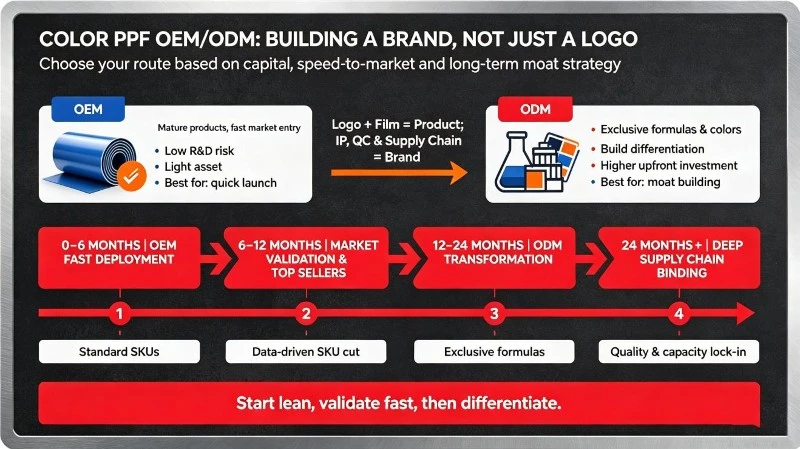
Building a colorful PPF brand is a capital allocation strategy rather than an overnight venture. For 90% of importers, attempting to launch a "big and comprehensive" ODM product matrix on the first day often leads to inventory overstock and tight cash flow.
The most efficient path to capital use follows a gradual four-stage evolutionary cycle:
Phase 1: OEM Execution (0–6 months) - Rapid launch and channel distribution
Utilize the factory-verified TPU color platform to lock in core packaging, labels, and the first batch of SKU product lines.
Main objective: Quickly deploy the brand with minimal R&D investment, concentrating 80% of resources on dealer training and channel acquisition.
Phase 2: Data Integration and Field Feedback (6–12 months) - Real-world validation
Track the sales rate of each market segment and monitor actual feedback such as bond strength, fit and regional color preference.
Main objective: Identify the top 20% of SKUs by sales volume and eliminate underperforming color numbers before re-purchasing.
Phase 3: Strategic ODM Transformation (12–24 months) - Engineering Differentiation
Upgrade high-performing product lines to own formulations: custom color matching, self-healing formulations for specific finishes, or adhesives optimized for different regional climates.
The primary objective: Convert the aggregated market data into exclusive product barriers to protect your profits from price wars.
Phase 4: Supply Chain Lockdown and Continuous Iteration (more than 24 months) - Long-term Dominance
Collaborate deeply with your manufacturing partners for preferential production quotas, customized quality control processes, joint inventory buffers, and next generation TPU research and development.
Primary objective: To maintain a flexible product architecture that dynamically ADAPTS to emerging automotive painting trends and market changes.
Final thoughts:
Market dominance in automotive paint is not won by launching the largest product catalog, but by solidifying and building a core product line with a high reputation and systematically deepening the product moat as revenue grows.
Conclusion Of The Article
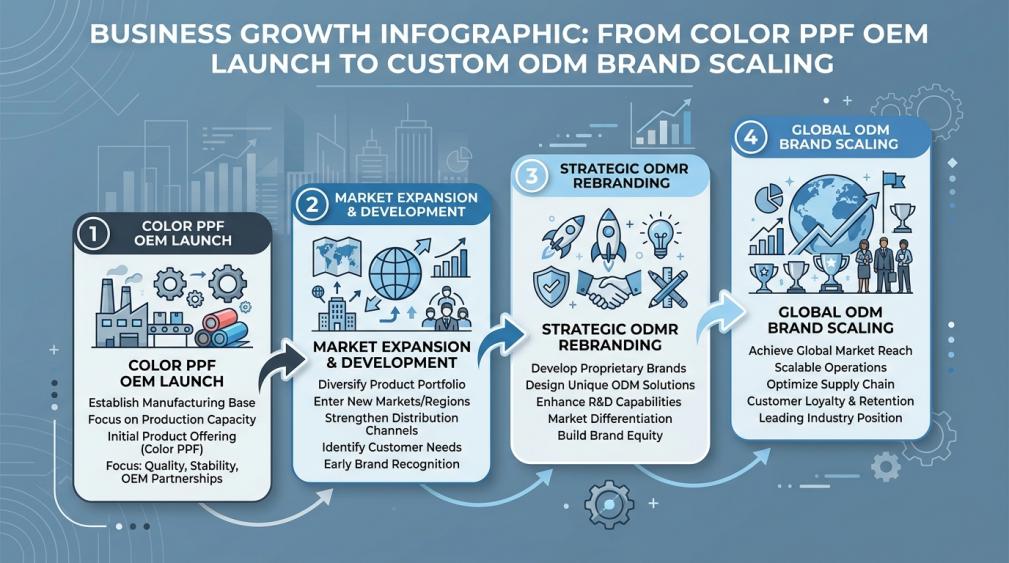
The essence of OEM and ODM is not to make products more complex, but to enable colored PPF brands to have clearer positioning, a more stable product system, and stronger market adaptability.
For importers and brand owners, truly valuable OEM/ODM partnerships go beyond simply changing a logo, designing a cardboard box, or developing a few color variations-they involve establishing long-term collaboration across multiple dimensions, including product development, branding, supply chain management, and market demand.
In the field of colored PPF, choosing a manufacturing partner who truly understands the product and brand logic, and can deliver consistent production and ongoing development capabilities, is often more important than simply pursuing the lowest procurement price.
If you're planning to build your own Color PPF brand, OEM and ODM should not merely be procurement options, but can become integral parts of your overall brand and market strategy.
Starting with mature products, continuously optimizing through market validation, and then gradually building one's own product system-this may be the more realistic path for a colored PPF brand to achieve long-term growth.
CTA Call To Action
Are you ready to offer your customers a more professional and distinctive colored paint protection film solution?
Leonardo Materials Technology, a TPU PPF manufacturer, offers OEM and ODM support for overseas importers, distributors, and brands regarding Color PPF. From established product systems and color options to brand packaging, roll specifications, and customized products, we provide flexible collaboration solutions tailored to diverse markets.
If you're looking for colored PPF products that match your brand positioning, feel free to contact us to learn more about product specifications, sample testing, and OEM/ODM collaboration options.
Build your Color PPF brand with a reliable manufacturing partner.


